
Reading Agent Output for Drift
Spot guessing, compression, and drift early in agent output.
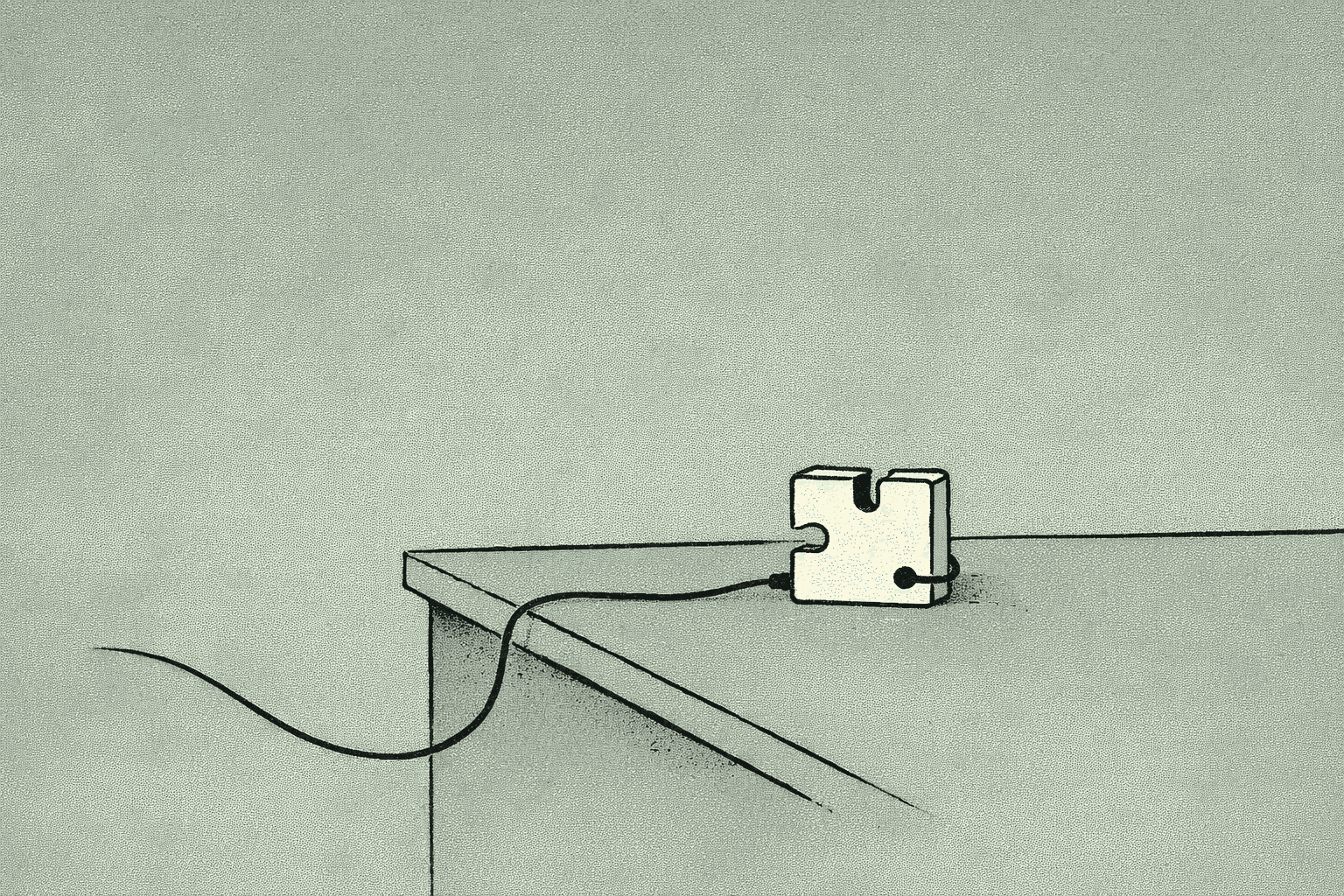
Agentic coding teams spend a lot of time reading output, not just writing prompts. That output is not only code. It is also the shape of the work: what the agent notices, what it skips, what it repeats, and where it starts to improvise. Those are signals. If you learn to read them, you can catch problems earlier.
A small example: a comment about an image that may be a ChatGPT-generated halftone or dither effect. On its own, that is not a coding insight. But it does point to a useful habit for agentic teams: treat visible artifacts as evidence of how the system is reasoning. When an agent is asked to produce something and the result looks off, the mismatch is often more informative than the output itself.
In coding workflows, the same pattern shows up in code diffs, test runs, and summaries. An agent may produce a plausible answer while missing the actual constraint. It may compress a problem into a familiar template. It may overfit to style and underfit to structure. The trick is to notice those failures as early signals, not just bad results.
What the signal looks like
A few recurring patterns are worth watching for.
- Overconfident approximation. The agent gives a polished result that fits the surface shape of the request but misses a key detail.
- Template drift. The output starts to resemble a familiar pattern instead of the task at hand.
- Constraint loss. One or two requirements survive, but the rest disappear.
- Style substitution. The agent focuses on appearance, naming, or formatting when the real work is structural.
These are not rare edge cases. They are normal failure modes when the task is underspecified or the context is noisy. The practical question is not whether they happen. It is how quickly you can detect them.
How to use the signal in practice
Start by making the first pass cheap and local. Ask the agent for a small artifact that exposes its reasoning: a short plan, a narrow diff, a minimal reproduction, or a test outline. Do not ask for the full solution first. Full solutions hide drift until late.
Then inspect the shape of the result.
If the agent keeps returning the same kind of answer across different tasks, that is a sign it is leaning on a template. If the output is visually tidy but semantically thin, it may be optimizing for plausibility. If it introduces details you never asked for, it may be filling gaps with guesses.
A useful response is to narrow the next step. Restate the constraint that was lost. Remove optionality. Ask for one concrete artifact that can be checked. For example:
- “Show only the files you would change.”
- “List the exact assumption you are making.”
- “Write the smallest test that would fail before the fix.”
- “Explain why this approach fits the constraint I gave.”
These prompts are not magic. They work because they force the agent to expose structure instead of hiding behind a fluent answer.
Tradeoffs and limitations
Reading signals is useful, but it is not free.
First, it adds review work. Someone still has to inspect the artifact and decide whether the signal is real. Second, it can create false alarms. A terse or unusual output is not always a bad one. Some tasks genuinely need a compact, unconventional answer. Third, it depends on the reviewer knowing what to look for. Teams without a shared standard will disagree about whether the agent drifted or simply chose a different valid path.
There is also a limit to how much you can infer from style. A neat output does not guarantee correctness. A messy output does not guarantee failure. The signal is strongest when you compare the artifact against a known constraint, a test, or a prior state.
A simple team practice
If your team uses agents regularly, add one review question to the loop: “What does this output suggest the agent believed the task was?” That question is small, but it changes the review from pass/fail to diagnosis.
You can make it even more concrete:
- Capture the first artifact the agent produces.
- Compare it against the original constraint.
- Mark any missing or invented assumptions.
- Decide whether to refine the prompt, narrow the task, or switch to a more testable step.
This is especially useful when the task is visual, structural, or hard to specify in one sentence. In those cases, the artifact itself becomes the best evidence of whether the agent understood the job.
Methodology note
This fits the Review step: inspect the first artifact for missing constraints before you let the agent expand the scope.
Why this matters for agentic teams
Agentic workflows fail in predictable ways when teams trust the first fluent answer. The better habit is to treat early output as a diagnostic surface. That does not mean being skeptical of everything. It means being specific about what the output is telling you.
If the agent is guessing, the signal is usually visible. If it is compressing, the signal is usually visible. If it is drifting toward a familiar pattern, the signal is usually visible. The job is to slow down just enough to read it.
That is a modest practice, but it scales well. Teams that catch drift early spend less time repairing large, polished mistakes later. And in agentic coding, that is often the difference between a fast loop and a noisy one.
Related research
Coding Plans That Lower Agent Cost
A short plan can cut agent spend and reduce rework when the task is clear.
Long-Running Agent Loops
Why long-running coding agents help on iterative, verification-heavy tasks.

Agent Loops for Messy Code
Practical patterns for keeping coding agents useful on messy tasks.